
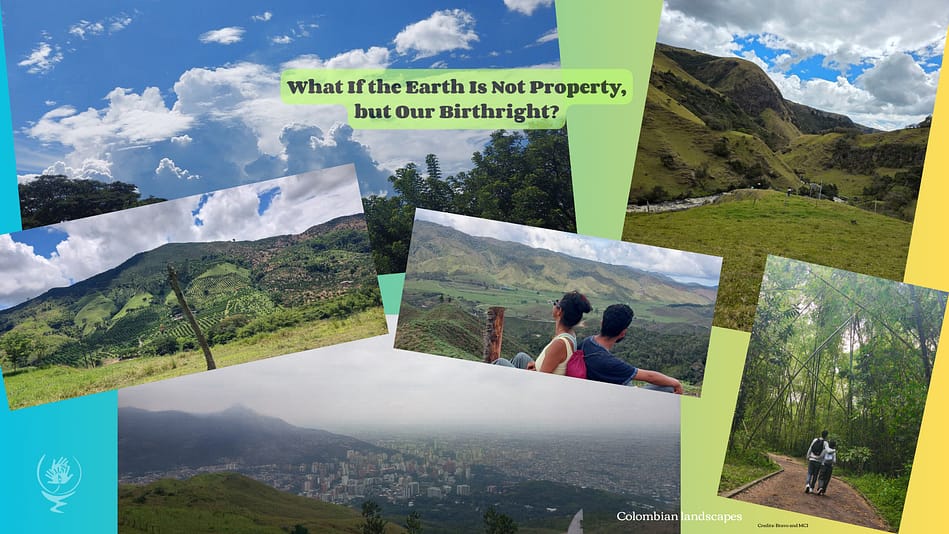
As we honor the Equinox and Earth Day,
we are invited to remember something both ancient and urgent: the Earth is not a commodity. She is our birthright, our shared home, and a living system to which we belong.
In a time when so much of life has been reduced to transaction, extraction, and short-term gain, these sacred moments call us back to relationship. They remind us that the Earth is not merely a surface to divide, exploit, and profit from. She is the foundation of life itself—generous, intelligent, and worthy of respect.
At MCI, alongside like-minded organizations and communities such as theIU.org, we stand for a more just relationship with land, people, and our shared future. We believe the Earth has rights. We believe communities deserve to live with dignity. And we believe that when land is approached with stewardship rather than exploitation, humanity has a chance to heal some of its deepest fractures.
This vision is deeply connected to my own work at the intersection of cultural intelligence, collective responsibility, and human-centered systems. To honor the Earth is also to honor memory, belonging, and the generations to come. It is to ask more courageous questions about economic justice, stewardship, and the kinds of societies we are building.
Are we creating systems that uplift life—or systems that separate people from one another, and from the living world that sustains them? Why do so many people remain unhoused while so much land is controlled, concentrated, and treated as profit? And who, in truth, does the land belong to?
Land is not a human invention, and its value does not arise in isolation; it is shaped by nature, community, and the shared conditions that make life possible.
For me, this is more than an environmental question. It is a cultural, ethical, and human one.
When we speak of the rights of the Earth, we are also speaking of the dignity of peoples, the wisdom of communities, and the responsibility of institutions. We are speaking about how land, identity, and belonging are deeply intertwined. We are speaking about a time in which development must no longer mean disconnection, and progress must no longer come at the cost of life itself.
This is why the Equinox and Earth Day matter. They are more than symbolic dates on a calendar. March 20, 2026, is an invitation to pause, reflect, and realign. It is a call to listen more carefully to the wisdom of the Earth, to support policies and practices that protect her and protect us, and to work across cultures, sectors, and generations in defense of what should never have been reduced to mere profit.
The Earth is not only where we live.
She is part of who we are.
Protecting her rights is inseparable from protecting our common future.
This season, let us move beyond symbolic concern and into measurable commitment. Let us support policies, partnerships, and practices that protect the Earth while reducing poverty in real and measurable ways, eradicating hunger, addressing displacement, and restoring dignity. Let us insist on systems that advance life rather than destruction—and translate our values into action, with the urgency, courage, and collective responsibility this moment demands.
With gratitude to theIU.org and all partners working toward economic justice, stewardship, and planetary healing.
ARTÍCULO — VERSIÓN EN ESPAÑOL
¿Y si la Tierra no fuera propiedad, sino nuestro derecho de nacimiento?
Por Lilian Calvache Muñoz
Al honrar el Equinoccio y el Día de la Tierra, se nos invita a recordar algo tan antiguo como urgente: la Tierra no es una mercancía. Es nuestro derecho de nacimiento, nuestro hogar compartido y un sistema vivo al que pertenecemos.
En un tiempo en el que gran parte de la vida ha sido reducida a transacción, extracción y ganancia a corto plazo, estos momentos sagrados nos llaman a volver a la relación. Nos recuerdan que la Tierra no es simplemente una superficie para dividir, explotar y lucrarse de ella. Es la base misma de la vida: generosa, inteligente y digna de respeto.
En MCI, junto a organizaciones y comunidades afines como theIU.org, abogamos por una relación más justa entre la tierra, las personas y nuestro futuro compartido. Creemos que la Tierra tiene derechos. Creemos que las comunidades merecen vivir con dignidad. Y creemos que cuando la tierra se aborda desde la responsabilidad y la buena administración, en lugar de la explotación; la humanidad tiene la posibilidad de sanar algunas de sus fracturas más profundas.
Esta visión está profundamente conectada con mi propio trabajo en la intersección de la inteligencia cultural, la responsabilidad colectiva y los sistemas centrados en lo humano. Honrar a la Tierra es también honrar la memoria, la pertenencia y a las generaciones por venir. Es atreverse a formular preguntas más directas sobre la justicia económica, la buena administración y el tipo de sociedades que estamos construyendo.
¿Estamos creando sistemas que elevan la vida, o sistemas que separan a las personas entre sí y del mundo vivo que las sostiene? ¿Por qué tantas personas siguen sin hogar mientras tanta tierra es controlada, concentrada y tratada como fuente de lucro? Y, en realidad, ¿a quién le pertenece la tierra?
La tierra no es una invención humana, y su valor no surge de manera aislada; está moldeado por la naturaleza, la comunidad y las condiciones compartidas que hacen posible la vida.
Para mí, esto es más que una cuestión ambiental. Es una cuestión cultural, ética y humana.
Cuando hablamos de los derechos de la Tierra, también hablamos de la dignidad de los pueblos, de la sabiduría de las comunidades y de la responsabilidad de las instituciones. Hablamos de cómo la tierra, la identidad y la pertenencia están profundamente entrelazadas. Hablamos de un tiempo en el que el desarrollo ya no debe significar desconexión, y el progreso ya no puede alcanzarse a costa de la vida misma.
Por eso importan el Equinoccio y el Día de la Tierra. Son más que fechas simbólicas en un calendario. El 20 de marzo de 2026 es una invitación a pausar, reflexionar y realinearnos. Es un llamado a escuchar con mayor atención la sabiduría de la Tierra, a apoyar políticas y prácticas que la protejan y nos proteja a todos, a trabajar entre culturas, sectores y generaciones en defensa de aquello que nunca debió reducirse a simple materialismo.
La Tierra no es solo el lugar donde vivimos. Es parte de quienes somos. Proteger sus derechos es inseparable de proteger nuestro futuro común.
En esta temporada, vayamos más allá de la preocupación simbólica y entremos en un compromiso tangible. Apoyemos políticas públicas, alianzas y prácticas que protejan la Tierra mientras reducen la pobreza de manera real y medible, erradican el hambre, atienden el desplazamiento y restauran la dignidad. Insistamos en sistemas que impulsen la vida en lugar de la destrucción y traduzcamos nuestros valores en acción; con la urgencia, el valor y la responsabilidad colectiva que este momento exige.
Con gratitud a theIU.org y a todos los aliados que trabajan por la justicia económica, la buena administración y la sanación del planeta.